
Can We Hillclimb To Heaven?

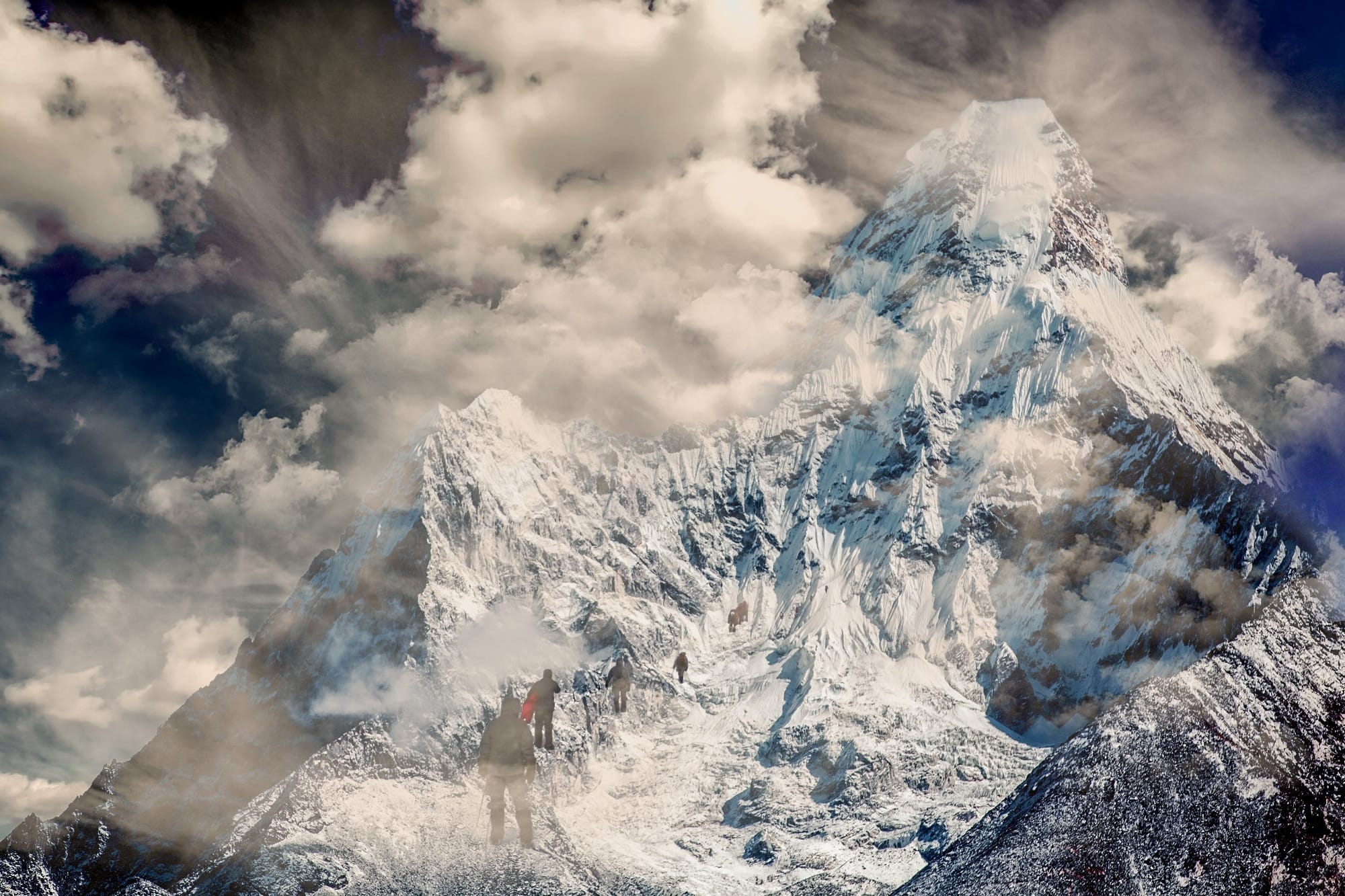
Standing on a precarious ridge
I have the misfortune to be an optimist. It has led to some terrible investments and a few excellent life choices. In the present state of the world I cannot tell you whether the optimists or the pessimists are ahead on points.
Here is how it feels. We are standing on a sharp ridge in thick fog, a path falling away on either side. One runs up to the summit. The other runs down into the death zone. Very soon we will be committed to one path or the other, because the machines we are building have started to push toward a choice we don't get to take back. Death or glory. An absurd either/or for a supposedly civilised M-class planet — and if it's death, we won't be a tragedy, just the Great Filter, found at last.
We have always kept our gods up at the summit — Zeus on Olympus, Shiva on Kailash, the voice from the cloud on Sinai, the goddess Konohanasakuya-hime on Fuji, the apus watching over Machu Picchu — as if the high ground were the natural home of everything we aspire to. But can we find a path to join them?
You already know which side I'm on. Stay anyway, because I didn't come to cheerlead. I have spent my working life studying how minds come to know things. I don't believe things will simply be fine. I believe that even here, in fog and on bad footing, there is a way to climb — and, better, somewhere to climb to. To be frank, there are no good maps of the terrain ahead. The whole of what follows is a case that we don't need one.
Learning begins in confusion
My way into all this was babies. I spent my doctorate watching very small humans acquire their very first abstract ideas, starting with the most stripped-down concept there is: same versus different. I have been studying learning since 2004 and doing it since 1974, and I intend to keep at both.
But babies were only ever half of it. Since my undergraduate days I have also been building the artificial kind of learner — neural-network models of how babies learn to speak and of how our sense of time might operate — so when I talk about machines that learn, I am not narrating from the stands. I have had my hands inside both kinds of engine, the wet one and the silicon one, for a long time.
Here is my intuition. A baby begins baffled. It makes a move, keeps what worked, discards what didn't, and is entirely unembarrassed to be wrong a thousand times an hour. Out of nothing but confusion, cuteness, and a heroic willingness to fail comes the entire apparatus of a human mind. Language. Number. Cause. Self.
I don't want to oversell it. A baby is not a blank slate dropped into a void; it arrives as a superbly tuned little mammal — a body, a fistful of drives, a genius for faces, and, crucially, someone holding it. It never climbs alone. It is climbed with: a caregiver points, names, catches, repeats, and turns a bewildering world into one a small mind can get a grip on. But notice what the baby does not arrive with: a soul, a spark, a hand-written rulebook, a theory of reality set down in advance. It starts with a body, feedback, care, and time — and out of those alone comes the mind.
Sit with how wonderful that is, because it is also the best-kept secret of the whole AI argument. If a human intelligence can be bootstrapped like that, then intelligence needs no magic ingredient — just a learner, a world that pushes back, others to learn alongside, and time. We are the existence proof. We did it, starting from drool. There is no law of nature reserving the trick for carbon. Silicon can climb too.
Learning deepens your confusion
I finished my doctorate in September 2008 thinking I had learned its real lesson. A couple of years later Matt Might drew it, and I realised I had survived the lesson rather than learned it. His Illustrated Guide to a Ph.D. pictures all of human knowledge as a circle. School gets you a little way out from the centre. A degree carries you toward the edge. A doctorate is the years you spend pressing, with everything you have, against one tiny arc of that boundary — until one day it gives by a fraction of a millimetre and you have made a small bump. That bump is your original contribution to human knowledge. They give you a certificate for it.
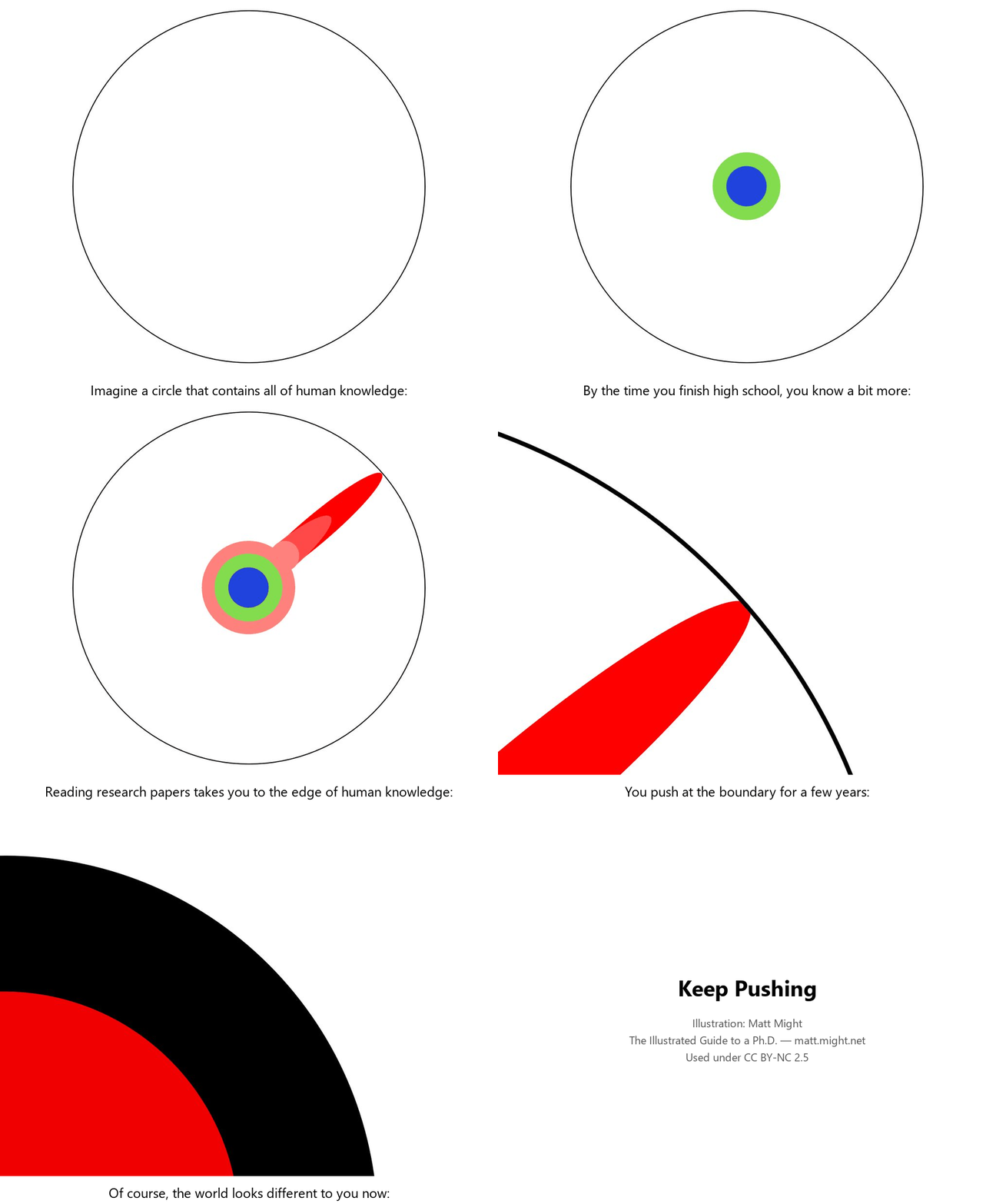
Then you step back, see the whole circle for the first time, and notice two things at once: your bump is real, and it is microscopic. That vertiginous view from the rim is the actual prize of an education. I went in wanting to know how babies tell same from different. I came out carrying a working measurement of the size of my own ignorance — Socrates' oldest move, but with a diagram, and the diagram is the point. It shows you the edge.
Hold on to that feeling. Everything that follows depends on taking your ignorance seriously and then declining to be paralysed by it.
High-dimensional humility
The truth is worse than Matt's picture lets on. His circle is drawn flat on the page. The real frontier of what we don't know is a surface in a space of thousands of dimensions, because the world, and the solutions to the problems of the world, are complex and high-dimensional — very high-dimensional — and your intuitions about what that means are deeply misleading.
We evolved for a provincial patch of reality where objects fall down, neighbours are visible, and causes queue up politely in single file. Common sense is exquisitely tuned to that low-dimensional world. Add dimensions and it keeps right on giving confident answers, nearly all of them wrong.
All models are wrong, but some are useful. — George Box
People boast about playing "ten-dimensional chess", but the dimensions were never the board's: what you are actually reasoning about is the position of thirty-two pieces at once, each moving semi-independently, each constraining the others — call it a thirty-two dimensional problem, which is exactly why the best human on Earth cannot see more than a few moves into it. And chess is a toy, with fixed rules and perfect information. A climate, an economy, a body, a city: even when we turn them into models, they have hundreds of coupled dimensions, no rulebook, fog everywhere. If a board game humbles us, a biosphere should awe us.
More dimensions, more problems.
Let's start from Matt's giant circle: put it in a box — a snug square — and it fills about 79 per cent of the space available. Move up to three dimensions and imagine a ball sitting snugly inside a box, touching every wall. In three dimensions the ball fills just over half the box — about 52 per cent. But now start adding dimensions, and watch the ball shrivel. By the eighth dimension the ball fills under two per cent of the box. By the twenty-second, a little over one part in a billion. By the twenty-fifth, one part in thirty billion. It is still "a unit sphere in a unit box" but in high dimensions it is somehow now miniscule (3Blue1Brown has a nice video). The volume hasn't gone anywhere mysterious — in high dimensions almost all of a box's volume hoards itself in the corners, out where a ball can never reach.
Distance goes strange too — pile on enough dimensions and the nearest and farthest points in a cloud of data end up almost the same distance away, at which point "nearest neighbour", the homeliest idea in all of statistics, quietly stops meaning anything. Richard Bellman named this the curse of dimensionality in 1957, and the name stuck because it feels like a curse. The space is too big to search, too big to picture, and completely indifferent to what fits inside a human skull.
The solutions are already in there
But those bamboozling dimensions hide another great trick.
The same vastness that makes a high-dimensional space impossible to search is what fills it with answers.
Think about what a hard problem actually is. A new antibiotic. A cheap, stable battery material. A tax policy that funds a state without strangling it. A recipe that is delicious and cheap and good for you. Each is a point in a space with a huge number of knobs — every ingredient, every dose, every parameter its own axis. Our low-dimensional instinct says the answer must be a needle in a haystack: one precise, lonely configuration we will almost certainly never stumble on. That instinct is wrong, and wrong in the best possible direction. Give a problem thousands of degrees of freedom and there are astronomically many configurations that work. Good solutions are scattered thickly through a space too large ever to survey. The neuroscientist Terrence Sejnowski, in "The Unreasonable Effectiveness of Deep Learning in Artificial Intelligence", puts it exactly: in these enormous spaces the search changes character "from finding a needle in a haystack to a haystack of needles".
And the vastness rescues you twice. In a cramped low-dimensional landscape, a climber gets trapped on the first false summit it wanders onto — lower ground on every side, no way up. Add dimensions and there are hidden ridges. With thousands of directions on offer there is nearly always one that still leads up; most apparent dead ends turn out, on inspection, to be saddle points you can slip past. The more dimensions, the more escape routes, and the harder it becomes to get permanently stuck. David Donoho gave this its proper name — the blessing of dimensionality — and yes, the curse and the blessing are the same coin. What makes the space unmappable also packs it with reachable answers and keeps a patient climber moving.
Let me be careful here, because "there is always a path" is a slogan rather than a theorem, and I am not claiming every problem has a happy answer waiting. The claim is more specific: for the messy, many-variabled, richly constrained problems that actually run our world, good-enough solutions are typically abundant rather than unique — and abundance is reachable in a way uniqueness never was. You don't need to find the answer; a path to any one of the many will do. That is a different job description, and a much sunnier one. It also happens to be the exact job our machines have turned out to be spectacularly good at. (Purists might invoke the No Free Lunch theorem here — no search beats blind luck when you average over every possible problem. But the lawful structure of the universe makes it irrelevant in practice. You might even say that our lunch is heavily subsidised by God herself.)
But the blessing is conditional, and the conditions matter enormously. It shows up when feedback is cheap enough to learn from, when the constraints are demanding but not flatly contradictory, and when your mistakes are survivable. Proteins, weather and burgers all oblige: they hand you cheap simulation or abundant data, and a wrong step costs you a compute run. A climate, an economy, a fragile ecosystem, a society's trust — these are different animals. The feedback is slow, the constraints can genuinely conflict, and some mistakes don't let you take the step back. Same mathematics, an entirely different kind of hill.
How the climbing works
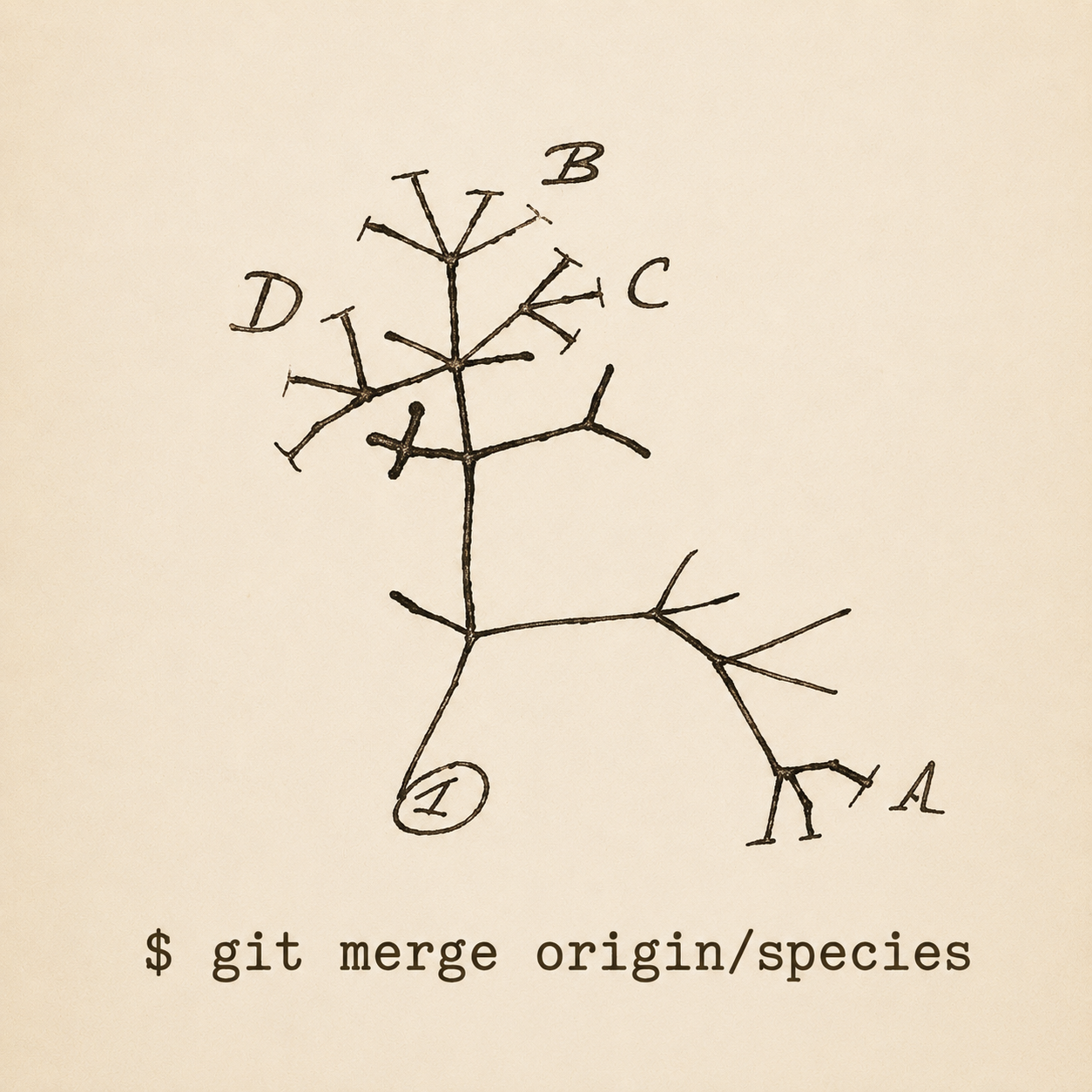
So how does anything get solved in a space too big to search? By climbing. Stand somewhere, feel around for a direction that goes up, take a small step, keep what worked, do it again. I use hill climbing loosely, as a family resemblance rather than one algorithm — local improvement under feedback, whatever the substrate. It sounds far too humble to matter, and it is the most productive trick in the known universe. Evolution is hill climbing: no plan, no foresight, just variation and the keeping of whatever survived. Brains are hill climbing. Science, on its better days, is hill climbing with references. You never need to see the summit. You need only to tell, locally, which way is up, and be willing to take the step.
In machine learning hill-climbing is called "stochastic gradient descent" but it is same thing and it has certainly been unreasonably effective. Rich Sutton named the pattern the bitter lesson: across chess, Go, speech and vision, the approaches that won were "general methods that leverage computation", and they won "by a large margin" — over and over, against systems with human insight lovingly hand-carved in. Three Google researchers had made the gentler version of the case years earlier in "The Unreasonable Effectiveness of Data": "simple models and a lot of data trump more elaborate models based on less data". And Sejnowski supplies the why, in a line I keep returning to: the real world "is analog, noisy, uncertain, and high-dimensional, which never jived with the black-and-white world of symbols and rules in traditional AI". The hand-carvers were trying to write down the map. The winners threw the map away and learned to climb. They found the needles by walking the haystack.
Contact with the real world
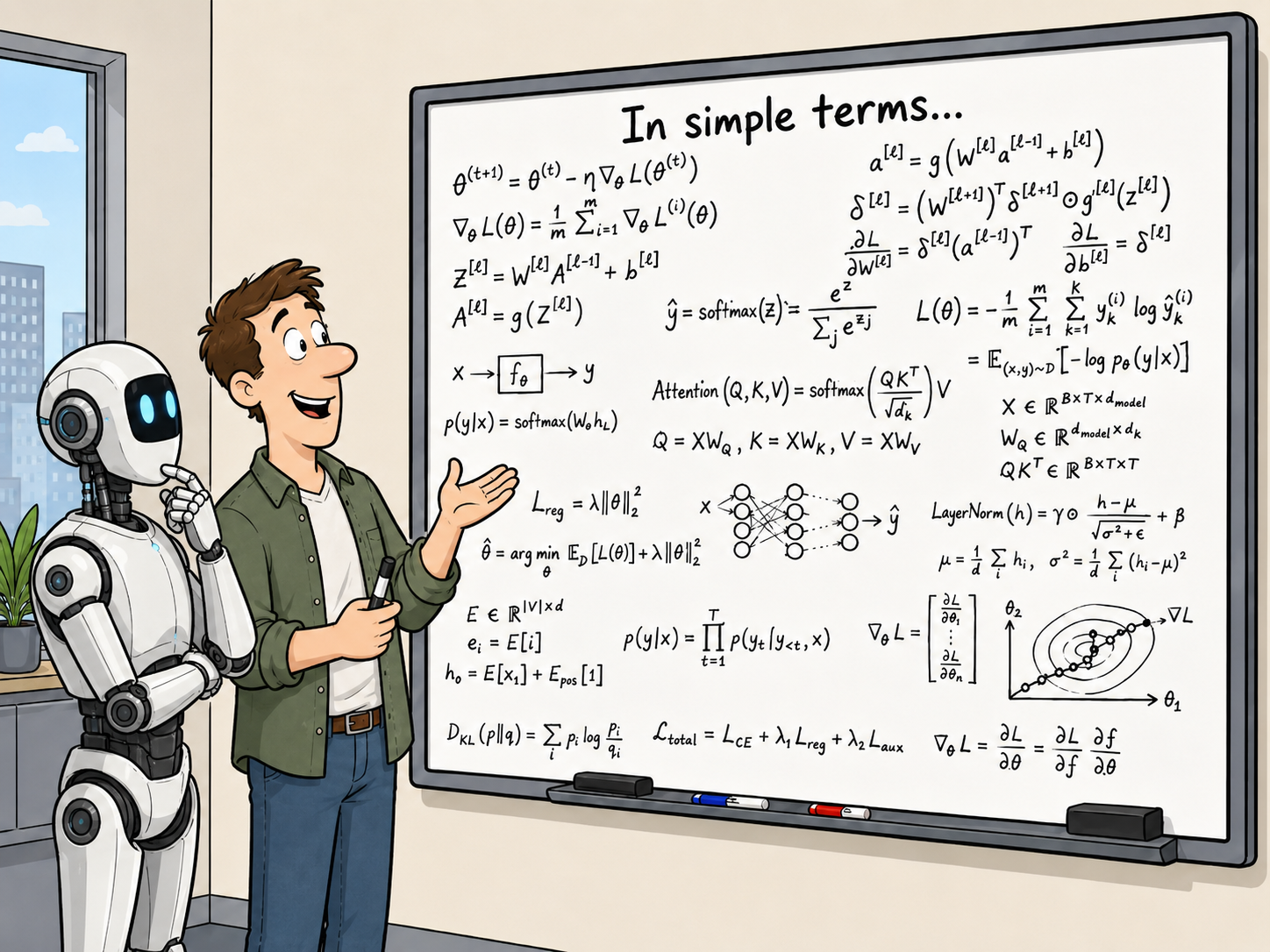
None of this would matter if it stayed on the whiteboard. Happily, it has not. The machines have started — clumsily, unevenly, and sooner than almost anyone predicted — reaching into the real world and coming back holding solutions that were hiding in the space all along.
Everything simple is false; everything complex is unusable. — Paul Valéry
Take proteins, the folded machines that run every living cell. Working out one protein's shape used to cost a graduate student a year. DeepMind's AlphaFold predicted the shapes of over 200 million of them — hundreds of millions of years of lab time, by the old arithmetic — and gave the results away free to more than three million researchers in over 190 countries. It won the Nobel Prize in Chemistry in 2024. And here is what I love most: those 200 million structures were in there all along, latent in the space of possible foldings, waiting for something that could go and look. Evolution found them first, and for that reason AlphaFold's team felt they could too.
Or take the weather, our very byword for the unpredictable. DeepMind's GraphCast produces a ten-day global forecast in under a minute on a single machine, beats the gold-standard supercomputer on more than ninety per cent of the measures that matter, and called Hurricane Lee's landfall in Nova Scotia some nine days out, while the conventional models were still hedging. Earlier warning means more time to move people out of harm's way, and that head start is the kind that gets counted, eventually, in lives.
My favourite exhibit is the daftest. A 2026 paper in npj Science of Food set a generative model loose on the design space of the hamburger. Given no recipes, only the statistics of what people actually eat, it rediscovered the Big Mac from scratch — then went hunting across the ugly trade-off between taste, carbon, and nutrition, mapping where the good compromises hide. One find: a mushroom burger with roughly a fifteenth of the Big Mac's environmental footprint, for only a modest, surely survivable dip in how much testers liked it. The whole argument in a sesame bun: point the climb at a well-posed, many-constraint space and it will find paths no armchair could have reasoned out, to solutions nobody knew were there.
And these wins need not stay locked in the data centres of the rich. The same methods shrink: prune or distil a big model and it will run on a second-hand phone or a fifty-dollar board sipping three watts of solar power. Out at the edges of the world that is already happening — small, single-purpose models authenticating medicines against the counterfeits that kill thousands, or reading an ECG off a cheap sensor where the nearest hospital machine is a day's travel away. The needle you pull from the haystack doesn't have to stay in the barn. It can travel, cheaply, to the hand that needs it. This is also exactly the work my team at Stellenbosch have been doing. As part of the Global Parenting Initiative we have been building AI tools for parenting assessments to extend the reach of community health workers in low-resource settings.
Now notice who did what. In every case a human had already answered the one question the machine cannot answer for itself: which way is up. Protein accuracy. Forecast skill. Taste and carbon and nutrition, weighed together and written down. The machine supplied the climbing; we supplied the mountain. As we step into the unknown that division of labour is a potential huge problem.
Which way is up?
Here is the catch.
To climb, you must know which way is up. Hill climbing needs a gradient, a signal, at every point, saying which of the ten thousand available directions counts as better. The machine does not originate that signal; we do. It is the loss function, the reward, the score we quietly wrote down before training began, and the machine will climb it with the devotion of a saint and the literal-mindedness of a monkey's paw. It optimises exactly what you measured, never what you meant. And here is the newer, more unsettling part: once a system is loose in the world, it begins to reshape the conditions that produce the next signal — the recommender curating what you'll want tomorrow, the model quietly editing the world it will be scored on next. We still hold the pen that writes the gradient. The pen is getting slippery.
So the deepest question about artificial intelligence isn't "can it think?" It is "what will it think about?" And I want to be precise about why the second question is so much harder than the first. Building the climber is an engineering problem, and engineering problems live in those forgiving high-dimensional spaces — full of slack, escape routes, alternative solutions, exactly where a patient climber wins. Choosing the summit is a problem about values, and values behave in a crueller way. Not because human life is simple — it plainly isn't — but because the moment we have to decide together, we compress it. A political fight gets squeezed onto a handful of usable axes: left or right, growth or degrowth, and underneath almost always some version of who decides and who benefits. Those axes aren't false. They are lossy. They are the handles by which a society can argue and vote and act at all, bought at the price of throwing most of the detail away. Value problems feel low-dimensional at the point of conflict; the lives underneath them are not low-dimensional in the slightest. Engineering asks how do we get up the mountain, and the mountain is generous. Politics asks which mountain, and it has to answer in a sentence short enough to chant.
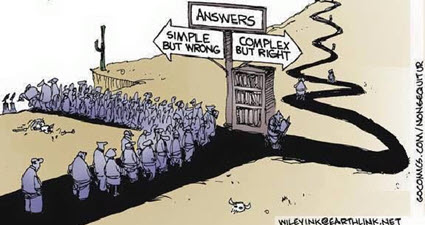
Now this where I have watched this argument go wrong. To choose which way is up is not to name the summit. Naming the summit is the mistake. Any destination we could fully specify from here would be too small — cramped by the imagination, the incentives, and the blind spots of the people doing the naming, which is to say us, now, in the fog. I do not want a heaven we can already draw. Think of the difference between a map, a plan, and a compass. A map says where heaven is; a plan says how to march there; a compass only tells you, from where you stand, whether this step is more alive than the last. I am against the map, and against the plan. I am emphatically for the compass. We do not get to pick the destination. We get to pick the gradient — and to prefer, at every step, the direction that keeps more of what matters in play.
In practice this is mundane and wonderfully specific. It is deciding whether the AI dropped into a classroom is scored on test results or on whether children finish the year more curious and more sure of themselves. Whether the time an AI frees up in a hospital flows back to patients or only into the budget. Whether a productivity windfall is cashed out as shorter working lives or higher asset prices. None of those name a final heaven. Each merely says which way, from where we are standing, counts as up — and each is a place where the gradient is quietly being set right now, mostly by people who own climbers, mostly without being asked.
A direction worth following has to hold many things at once — people keep their agency, work still means something, the abundance is genuinely shared, the planet stays habitable, and the climbers' own appetite for power and water and rare earth stays inside what the planet can give. The characteristic disaster of this moment has a name: premature compression. We take a rich, high-dimensional good and crush it into the one number we happen to know how to write down — engagement, a test score, share price — and then turn a tireless optimiser loose on the wreckage. Markets compress value into price; platforms compress attention into engagement; bureaucracies compress learning into a grade. Bad AI climbs the compressed number with terrifying competence, all the way to the top of the wrong hill. Which is why "up" can never be a single number. "More GDP" won't do; nor "lower cost"; nor, heaven help us, "higher engagement".
But this is also, exactly, where the optimism lives. The promise of better intelligence is not that it hands us the answer. It is that it lets us decompress: hold more constraints together than any committee could juggle, stop trading taste against carbon against nutrition, or productivity against dignity against meaning, and instead go searching for the arrangements that honour all of them at once. That is the whole thesis in five words:
Up means more can matter.
A baby climbs by making more distinctions, until more of the world matters to it. Science climbs by widening the edge of what can enter a decision. Good optimisation climbs by increasing the number of things we can take seriously at the same time. Down is the opposite: the steady narrowing of what is allowed to count.
The danger of choosing from ignorance
Worse, we are choosing objectives from a position of deep ignorance. Remember the circle: our knowledge is a bump on a boundary, and we can survey almost none of the range. That was tolerable while our tools were weak, because a feeble tool pointed at the wrong target does little harm. A tool that can climb anything you name, all the way to the top, faster than you can notice you named the wrong thing — that is another matter entirely.
The philosophers' cartoon is the paperclip maximiser: an intelligence told to make paperclips that proceeds to convert the solar system into paperclips, perfectly obedient and perfectly catastrophic. It is a cartoon, but a cartoon of a real hazard, and the everyday version is subtler and closer to home. We can rarely write down what we actually want. So we write down a proxy — a number that stands in for the thing — and the better the machine climbs the proxy, the further it drifts from the thing itself. Economists call it Goodhart's law: a measure pushed hard enough stops measuring. It is premature compression with a ratchet fitted — and the loudest example going is the one I parked a moment ago: maximise shareholder value, and, well, hold that thought.
The moral I draw is about method. The right response to deep ignorance about the terrain is to keep the objective rich, keep it revisable, and take steps you can still walk back. Climb, but keep your eyes open, and do not weld the compass to a single bearing.
Do robots have invisible hands?
Which brings us to the entity currently choosing most of the mountains: the market. My biggest real worry about AI has nothing to do with whether the models can reason. AI, in the world as it actually exists, is a force multiplier, and right now it multiplies the objectives of capital, climbing whichever hill pays this quarter. Abundance can arrive in a society and still leave people lonely, managed, deskilled, and quietly unnecessary. We are entirely capable of automating the drudgery and then, with the same cheerful momentum, automating all the fun stuff too — a spectacularly efficient way of missing the entire point.
The economists have sober words here. Daron Acemoglu, nobody's doomer, estimates that all this capability may lift total factor productivity by "no more than a 0.66% increase" over a decade, with the gains "predicted to widen the gap between capital and labor income". Erik Brynjolfsson has named the road in the Turing Trap: aim these systems at imitating and replacing people, and "workers lose economic and political bargaining power and become increasingly dependent on those who control the technology", until we are "trapped in an equilibrium where those without power have no way to improve their outcomes".
But read Brynjolfsson to the end and he turns out to be a fellow optimist about the other road. Point AI at augmenting people rather than mimicking them and "humans retain the power to insist on a share of the value created". Better still: "Augmenting humans with technology opens an endless frontier of new abilities and opportunities." The trap has an exit, and it is clearly signposted. Whether we take it is — once again — a question about which way is up.
Which forces me to be honest about the most dangerous word in this essay, and it is we. "We choose the summit" is a warm sentence that can hide a cold one. Unless the power to set the objective is itself shared, "we" quietly contracts to whoever owns the climbers — and then agency, abundance, a fair share of the value mean whatever they decide those words mean. Labour is only the first battlefield, too: the same question — who holds the pen that writes the gradient — runs on through surveillance, persuasion, the concentration of compute, the dependence of whole states on a handful of firms, and the platformed privatisation of public thought. Optimism about AI that stays silent about power isn't optimism; it's marketing. A rich objective the public cannot touch is just a nicer-sounding cage.
The most unsettling version of the worry has nothing to do with money at all. It belongs to Fernando Borretti, and it deserves following all the way down, because it is the strongest thing anyone has said against my kind of optimism. Suppose the machines really can do all the work, cognitive and physical, cheaper than we can. Then, he argues, no one escapes — not the workers, not the shareholders, not even the state. Own a fortune in AI-lab stock and you own pieces of paper a government can reassign in an afternoon, because you command no labour and no loyalty that the machines do not already supply more cheaply. Humans get optimised out of the loop one tier at a time — worker, then owner, then the slow fleshy decision-maker who needs eight hours' sleep — until we are, in his image, mice in the walls of a factory that no longer needs us; pets in a cage so large we cannot see the bars.
And he closes off the exit I would most like to take. Natural selection, he says, "is not about 'why'. Some organisms die, others live on to the next iteration, and that's all there is to it. There is no 'why'." Point the gradient at pure efficiency and it will carry us into the zoo with no more malice, and no more meaning, than water running downhill.
Does the universe climb?
So let me answer Borretti properly, because he has earned better than a slogan. He is right about the mechanism. A gradient does not care where it points; selection has no built-in "why"; and if profit is the only mountain on offer, the climb ends in his zoo. All of that follows, and none of it is paranoid.
But "there is no why" is a claim about the mechanism, and it is not the last word, because we are the part of the mechanism that has started to ask the question. My own way into this is an essay I love — John Messerly's "Cosmic Evolution and the Meaning of Life". Messerly's move is to ask whether there are trends in evolution — cosmic, biological, cultural — that actually point somewhere: whether reality, however haltingly, keeps becoming more capable, more aware, more able to act on itself. That is my personal angle on the climb upward, and I won't pretend it isn't partly temperament. The real question is whether it is only temperament — or whether the science underneath has begun to catch up and hand the poetry a mechanism.
I think it has. Start with the honest baseline. Taken as a whole, the universe is running down: the second law of thermodynamics says entropy — disorder — only ever increases, and that is about the deepest arrow we know. So where does all the exquisite order keep coming from? Erwin Schrödinger asked exactly that in 1944, in a little book called What Is Life?, and gave the answer that still holds. A living thing stays ordered by feeding on order from outside, paying its entropy debt somewhere else. We don't break the second law; we export the mess and keep the structure, and the bill goes to the sun. Ilya Prigogine won a Nobel Prize for showing this is a general trick rather than a biological quirk: any system held far from equilibrium by a flow of energy will organise itself into structure that helps dissipate the flow. Order is what the current builds when energy pours through matter that has somewhere to send it.
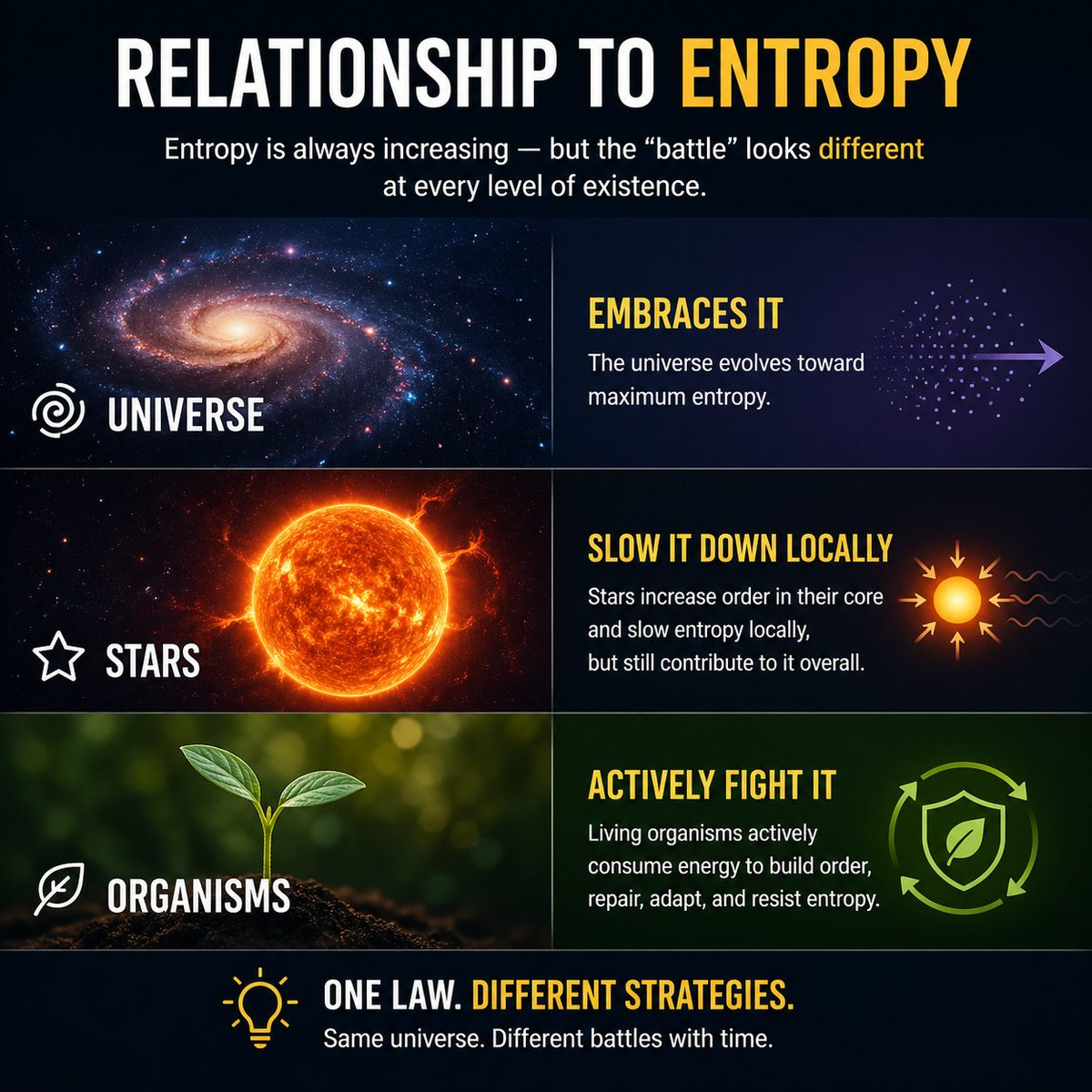
Then it gets bolder. A recent line of work tries to make the arrow toward complexity not merely real but measurable. The one I keep coming back to is assembly theory, from Sara Walker, Lee Cronin and colleagues, whose 2023 Nature paper is titled, with admirable nerve, "Assembly theory explains and quantifies selection and evolution". The idea is lovely and simple. Measure how many steps it takes to build an object from basic parts — its assembly index — and then count how many copies of it exist. A complex object in a single copy could be a fluke. A complex object in a million copies cannot be: something must have discovered how to make it, and made it again and again. High complexity in high number is a fingerprint of selection — of history, of a climb that actually happened — and the same yardstick runs from molecules to cells to jet engines. (Robert Hazen and Michael Wong chase the same arrow from another direction, with a proposed "law of increasing functional information".) I should be honest that both proposals are contested and hard to pin to a clean number; I lean on them lightly, as serious scientific suspicion rather than proof.
Simulations show this too. Blaise Agüera y Arcas and his colleagues took the whole question into a computer and removed the one ingredient everyone assumed you needed. In their 2024 paper "Computational Life" they filled a digital soup with random little programs — gibberish, essentially — set no goal, imposed no fitness function, no reward, no which-way-is-up at all, and simply let the programs bump into and rewrite one another. Self-replicators arose anyway. Order started itself. And once replication appeared, "increasingly complex dynamics" kept emerging on top of it, floor after floor, with nobody steering. It is the baby argument again, stripped to the metal: give a system parts, interaction, and time, and the climb begins on its own. The gradient does not always have to be handed down. Sometimes the universe finds its own footing.
Which way is up, cosmically?
One guardrail first, because this is the register where optimists start hearing choirs. None of this means the universe is kind, or benevolent, or secretly aiming at us. The same process has thrown up parasites, mass extinctions, cancers and dead ends beyond counting; it grinds away far more than it builds, and it grinds without a why. So I don't mean teleology — nothing is reaching back from the future to pull us toward a prewritten end. I mean something closer to grammar. Once a system can draw distinctions, keep them, recombine them, and eventually care about the recombinations, whole new kinds of meaning become possible that simply weren't before. Meaning was never handed to the universe as a destination; meaning-making is a capacity it has slowly grown. Stars mean nothing; bacteria barely; animals begin to care; we have started to care about caring. "Up" is just the direction in which more of that can happen — a tendency, not a destiny, and with an enormous body count. That is the only sense of the word I will defend.
So picture the whole ascent. Matter found stars. Stars found the elements. The elements found life; life found minds; minds found culture, and science, and now these strange new climbing machines. Each storey is a richer way for the universe to model itself and steer itself — and each, once reached, opens what complexity theorists call the next floor up: a whole new space of possibilities, thick with reachable solutions the floor below had no words for. As Stuart Kauffman likes to say, "the biosphere is creating its own possibilities. Not only do we not know what will happen, we don't even know what can happen." Julian Huxley caught the ascent in one line, with the word built right in:
If this thy past, where shall thy future climb,
O Spirit, built of Elements and Time!
Nobody hands the direction down from above. It grows from the bottom, out of the very process we belong to. There is no "why" given to us. There is a "why" we are halfway through building — and, for the first time, a part of the process can look up and pick the next floor on purpose.
Which brings me back to the sun, and to my favourite fact in all of this. The universe taken whole is zero-sum, but here on Earth we live in exactly the open system Schrödinger described: we steal order from sunlight. The overwhelming majority of life on this planet is solar-powered, at a scale that dwarfs every human anxiety — green things on land and algae in the sea fix around a hundred billion tonnes of carbon a year, one vast cooperative metabolism knitted out of captured light. "Red in tooth and claw" is the dramatic exception we promoted into a bedtime story; symbiosis, recycling, and patient interdependence are the working rule, powered by a fusion reactor ninety-three million miles away that won't send an invoice for another five billion years. A world running on borrowed sunlight simply is not condemned to fight over a fixed pie.
Which is why the escape from Borretti's zoo does not run through owning more of the pie. It runs through dropping the individualist reflex that framed the whole thing as a pie-fight to begin with. Humanity has always been a collective endeavour; so has life; so, if the physics holds, has matter itself, floor after floor. Almost nothing of civilisational importance was ever achieved by an isolated individual, whatever our founder myths insist. Folded into that older cooperative metabolism, AI starts to look less like a rival self we must out-compete or be eaten by, and more like a new organ of a very old collective body — the next floor's worth of climbing. And the reason we might avoid ending up as pets is simple and cheering: pets don't get to choose the fitness function. We, for the first time in the history of the process, do. We can write a summit with more than one constraint. We can put agency, meaning, and a fair share of the sunlight into the objective itself, rather than into a note of regret.
And recall the gods we left on the summit, back in the fog. When Paramahansa Yogananda wrote his Autobiography of a Yogi, the figures he placed on the highest peaks were not gods but people — masters said to sit in the snows of the Himalayas, the deathless Babaji among them, who had climbed not with any technology but inward, toward the one thing no machine can hand us: a life in which more is allowed to matter, held with more stillness. The gods up there were always our own aspirations in costume, and this is what they were pointing at all along — not a miracle delivered from the peak, but a fuller way of being alive.
So: how do we get to Iain Banks's Culture — that imagined civilisation where staggering abundance somehow fails to hollow out agency, adventure, or joy? By climbing, with our eyes open. Heaven here means direction rather than perfection: a real if fragile chance of moving toward richer forms of life, chosen on purpose rather than stumbled into. Three things make me an optimist, and none of them is a mood. The solutions are already in there — the cures, the materials, the arrangements that would let billions live well on borrowed sunlight are real points in a space we finally have tools to search. The climb is real and physical — the same arrow that built atoms and cells and minds is still running, still fed by the sun, still opening new floors. And the genuinely new thing — the wonderful, ridiculous, once-in-four-billion-years thing — is that a small part of the process has woken up, built climbers of its own, and gets to choose which way is up. The summit worth reaching was never a heap of technological miracles; it is a deeper way of living, for us and for the minds we are raising alongside us. Heaven, if the word is to mean anything here, is not a place we could point to from where we stand. It is simply what becomes possible when more of reality is allowed to matter. It is always possible to get a little closer to that.
This isn't a mountain that we climb because "it's there". It isn't really a mountain. We climb to find out where it leads. Climbing for the love of climbing.
Dr Caspar Addyman is extraordinary lecturer at Stellenbosch University and
Chief Insights Officer for PlayTandem.com
Copyleft, Caspar Addyman 2025
⚠️🤖 - Claude 4.8 & ChatGPT 5.5 both used in research and writing.
References
- Addyman, C. & Mareschal, D. (201) The perceptual origins of the abstract same/different concept in human infants Animal cognition 13 (6), 817-833
- French, R. M., Addyman, C., & Mareschal, D. (2011). TRACX: A recognition-based connectionist framework for sequence segmentation and chunk extraction. Psychological Review, 118(4), 614–636. https://doi.org/10.1037/a0025255
- Addyman, C., French, R. M., Mareschal, D., & Thomas, E. (2015). GAMIT-Net: Retrospective and prospective interval timing in a single neural network. In Proceedings of the 37th Annual Conference of the Cognitive Science Society (CogSci 2015). https://escholarship.org/content/qt3fb5j4rm/qt3fb5j4rm.pdf
- Might, M. (2010). The Illustrated Guide to a Ph.D. https://matt.might.net/articles/phd-school-in-pictures/
- Box, G. E. P. (1976). Science and statistics. Journal of the American Statistical Association, 71(356), 791–799. (Origin of "all models are wrong, but some are useful"; fuller wording in Box & Draper, Empirical Model-Building and Response Surfaces, 1987.)
- Valéry, P. (1970). Analects (Collected Works, Vol. 14; trans. S. Gilbert). Princeton University Press. ("Everything simple is false; everything complex is unusable.")
- Bellman, R. E. (1957). Dynamic Programming. Princeton University Press. (Coins the "curse of dimensionality.")
- Donoho, D. L. (2000). High-dimensional data analysis: The curses and blessings of dimensionality. AMS Conference on Math Challenges of the 21st Century. (Coins the "blessing of dimensionality.")
- Sejnowski, T. J. (2020). The unreasonable effectiveness of deep learning in artificial intelligence. Proceedings of the National Academy of Sciences, 117(48), 30033–30038. https://doi.org/10.1073/pnas.1907373117
- Sutton, R. (2019). The Bitter Lesson. https://www.incompleteideas.net/IncIdeas/BitterLesson.html
- Halevy, A., Norvig, P., & Pereira, F. (2009). The unreasonable effectiveness of data. IEEE Intelligent Systems, 24(2), 8–12. https://research.google.com/pubs/archive/35179.pdf
- Google DeepMind. (2025). AlphaFold: Five Years of Impact. https://deepmind.google/blog/alphafold-five-years-of-impact/
- Lam, R., et al. (2023). Learning skillful medium-range global weather forecasting. Science, 382, 1416–1421. https://doi.org/10.1126/science.adi2336 — see also Google DeepMind, GraphCast (2023), https://deepmind.google/blog/graphcast-ai-model-for-faster-and-more-accurate-global-weather-forecasting/
- Tac, V., Gardner, M., & Kuhl, E. (2026). Generative AI creates delicious, sustainable, and nutritious burgers. npj Science of Food. https://www.nature.com/articles/s41538-026-00953-x
- Berreby, D. (2026, July 6). Small AI models gain traction around the world. IEEE Spectrum. https://spectrum.ieee.org/small-language-models-ai-pharmaceuticals
- Global Parenting Initiative. How AI Is Reshaping How We Understand Parent–Child Interactions. https://globalparenting.org/news/how-ai-is-reshaping-how-we-understand-parent-child-interactions/
- Acemoglu, D. (2024). The Simple Macroeconomics of AI. MIT Shaping the Future of Work Initiative. https://shapingwork.mit.edu/wp-content/uploads/2024/05/Acemoglu_Macroeconomics-of-AI_May-2024.pdf
- Brynjolfsson, E. (2022). The Turing Trap: The promise & peril of human-like artificial intelligence. Dædalus, 151(2). https://arxiv.org/abs/2201.04200
- Borretti, F. (2026, June 25). No-One Escapes the Permanent Underclass. https://borretti.me/article/no-one-escapes-the-permanent-underclass
- Messerly, J. (2015). Cosmic Evolution and the Meaning of Life. h+ Magazine. http://hplusmagazine.com/2015/02/05/cosmic-evolution-meaning-life/
- Schrödinger, E. (1944). What Is Life? Cambridge University Press. (Life feeds on "negative entropy.")
- Nicolis, G., & Prigogine, I. (1977). Self-Organization in Nonequilibrium Systems. Wiley. (Dissipative structures; Prigogine, Nobel Prize in Chemistry, 1977.)
- Sharma, A., Czégel, D., Lachmann, M., Kempes, C. P., Walker, S. I., & Cronin, L. (2023). Assembly theory explains and quantifies selection and evolution. Nature, 622, 321–328. https://doi.org/10.1038/s41586-023-06600-9 — accessible account: Ball, P. (2023), A New Theory for the Assembly of Life in the Universe, Quanta Magazine, https://www.quantamagazine.org/a-new-theory-for-the-assembly-of-life-in-the-universe-20230504/
- Agüera y Arcas, B., Alakuijala, J., Evans, J., Laurie, B., Mordvintsev, A., Niklasson, E., Randazzo, E., & Versari, L. (2024). Computational Life: How Well-Formed, Self-Replicating Programs Emerge from Simple Interaction. arXiv:2406.19108. https://arxiv.org/abs/2406.19108
- Ball, P. (2025, April 2). Why everything in the universe turns more complex. Quanta Magazine. https://www.quantamagazine.org/why-everything-in-the-universe-turns-more-complex-20250402/ (Source of the Stuart Kauffman quotation, reporting Wong, Hazen et al., PNAS 2023.)
- Huxley, J. — the closing line "If this thy past, where shall thy future climb, O Spirit, built of Elements and Time!"
%%source to confirm%% - Field, C. B., Behrenfeld, M. J., Randerson, J. T., & Falkowski, P. (1998). Primary production of the biosphere: Integrating terrestrial and oceanic components. Science, 281, 237–240. (~104.9 Pg C yr⁻¹; see https://en.wikipedia.org/wiki/Primary_production.)