
The Millennium Guarantee

A confabulation
I.
Maya's knife came in a wooden box lined with moss. No packing foam, no leaflet in twelve languages. Just the blade, and a single card of handmade paper, and on the card, in letters that had been pressed into it rather than printed on:
ÆTERNUM
This implement is guaranteed for one thousand years.
Serial 2023-00943
Should it dull, chip, or fail in any way, write to us. We will repair or replace it. The guarantee passes to your heirs.
She turned the knife over in her hands. The steel was not bright. It lacked the cheap mirror shine that means a factory somewhere stamped ten thousand of these out before lunch. This was darker, and it had weather in it. When the light moved, the surface moved with it: long grey banks of pattern rolling over one another, the way thunder clouds stack up on a hot afternoon. She tilted the blade and the storm tilted. She held it still and it went on moving anyway, slowly, as though the steel were in no particular hurry to settle.
She had paid five hundred and forty euros for it. Her sister said she could have got a whole set for that, with a block and the scissors and the little sharpener thing, and Maya agreed that she could, and did not try to explain.
The truth was she had not gone into the shop meaning to buy anything. But the light had moved on a dark blade in the window, and the steel had moved with it, and Maya had stood on the pavement being, briefly, eight years old — at her grandmother's kitchen table, watching a knife go through onions. Her grandmother's knife had been like that: dark, and old, and hers. It had been old when her grandmother was young. Nobody else was allowed to wash it. Her grandmother, who trusted almost nothing that had been invented since the war, trusted that knife the way you trust a person, and standing on the pavement thirty years later Maya could still hear it going through onions and hitting the board, the most certain sound in her childhood.
She could not have said what the knife in the window was so certain of. She only knew that she wanted, in a life that renewed its lease annually — the flat, the job, the phone whose battery failed like clockwork, the only part of it that did — one object that had made up its mind. Five hundred and forty euros, divided by a thousand years, is fifty-four cents a year. She did the arithmetic right there in the shop, the way you check whether a thing is mad or only unfamiliar. It came out the same either way.
The guarantee passes to your heirs. Maya had no heirs and intended none — a thing she had settled without drama years ago, the way some people simply know they will never emigrate. So the last line on the card was addressed to nobody. She read it a few times, that first evening: a promise made out to people who would never exist. It should have bothered her, and did not. If anything she liked it. The knife's future was simply longer than its paperwork, and would have to find its own way — a small piece of it with her fingerprints worn off.
She cut a tomato, because it was what the fruit bowl had in it. The blade went in without asking, the two halves fell open on the board, and that was all: no sawing, no skin dragging, just the small knock of the edge on the wood. She stood there holding a five-hundred-and-forty-euro knife over a forty-cent tomato, and it was too late. She was already fond of it.
II.
The company was called Æternum, and it did not behave like one.
It worked out of a converted monastery in the hills above Kyoto. There was no phone number, and no chat window with a small waving cartoon in it. There was a postal address, and an email address that was answered, every time, within seven days — as though a week were the correct and considered interval between a question and its answer.
The catalogue was short: knives, cookware, hand tools, one model of bicycle, some furniture, some ceramics. The guarantees were the actual product. Fifty years for the standard pieces. Two hundred for the artisan ones, each signed. A thousand for what they called heirloom grade. Ten thousand for bridges, harbours and anything else that might be called public infrastructure — only seven of those had ever been issued.
The records said the firm was founded in 1987, but the records sat on top of older records, and those on older still, until the trail stopped being the kind of thing that leaves records at all. One business journalist gave up and called the arrangement "a very patient sort of haunting," which the company neither confirmed nor sued over.
Its public face was a woman named Yuki Tanaka — tall, unhurried, silver at the temples — who gave few interviews and said much the same thing in each. Our competition is not other companies. Our competition is entropy. One photograph ran with every profile, because it was the only one the company would release: Yuki in the monastery garden, undated. People took it for recent. Someone eventually noticed it had also run, in the same crop, in a trade journal from the 1980s.
III.
Maya's grandmother died in her sleep at the far end of an October, in the bed she had slept in for sixty years, which was more or less the only thing she had ever asked of anyone.
The funeral was small: Maya, her mother, three pensioners from the village. The estate was smaller — a house with more mortgage than equity, a drawer of costume jewellery, a shelf of ceramic cats nobody had the heart to value. And, set aside, with Maya's name on it in a hand gone shaky, a wooden box.
She knew its weight before she opened it. The box was old, the corners worn pale, the moss inside long since dried to a grey felt — but it was the same box, or its grandparent: the same idea of a box, made by people who held that a knife deserved to arrive somewhere soft. Inside lay the knife from the onions. Of course it was. She carried it to the window and the light caught it and the steel began, slowly, to roll. The same weather. The same thunderheads, stacking and deciding. It is a particular feeling, to have known a face your whole life and only now learn its name.
The card was the same handmade card, gone the colour of weak tea. The front gave a serial — 1847-00133 — and a name: Elsa. Made for a wedding, in a village that had been three different countries since.
The back was where the women were.
They had signed it, one beneath the next, each keeper in her turn: no dates, no messages, just names in fading inks. Elsa, in copperplate. A Margarethe. An Ana, the surname changed. A Sofia, in pencil, almost gone — the great-grandmother Maya knew only as a frame on the sideboard. And sixth, her grandmother: a girl's round signature from some year in the fifties, nothing at all like the hand on the box. It was the one piece of paper a family like hers could be sure nobody would ever throw away.
Maya read the column twice. Six women, her ancestors, handing one thing down a line she could feel running clean through her. But there it stopped. By her own steady choice, there would be no descendants, and she felt about that exactly what she always had, which was not grief. You cannot grieve a choice you never wanted to take.
What she felt instead, over the following weeks, was the problem of the drawer.
Two knives lay in it now, side by side, near enough identical: dark steel, weather rolling through both, each guaranteed to outlast every person Maya had ever met. One cook. One board. One onion at a time. She used Elsa's — of course she used Elsa's; that was not even a decision — and her own knife, two years old, barely run in by the standards of the house it now shared, lay in the drawer with its whole millennium in front of it and nothing to cut.
A person with children would never have noticed the problem. The spare would already have a name on it, a kitchen waiting somewhere downstream. Maya noticed the problem.
So she did the sensible thing, and wrote to Æternum asking for a refund.
She was polite about it, and she explained the situation: the knife was flawless, but she had lately inherited its near-twin — serial 1847-00133, a hundred and seventy-six years its senior and every bit as sharp — and she found herself holding one more eternity than she had any use for. She quoted both serials and offered to pay the postage.
The answer came in seven days, as it always did. They were sorry. They did not do refunds. In a thousand and some years of trading — the phrase slid past as though it were nothing — no object of theirs had ever come back for money. The guarantee ran in one direction only: onward. It had no provision for reverse.
As for the older blade: they had looked it out in the order book. Made for a wedding, in the spring of 1847. Since then, nothing — their records were of making, not of keeping, and a knife that never needed them was the knife they had meant to make. But an 1847 still in its first family, still at work, was not something they heard of often, and two of their blades in one pair of hands was rarer than she might suppose. If she wished to discuss what might be done with the surplus one, they would prefer to do it in person. Would she care to come?
IV.
She went in winter. The train emptied as it climbed, the way trains do when they are taking you somewhere that is not on the way to anywhere else. From the last station, a road; from the road, a path; from the path, a gate in a wall that had been a wall for a very long time.
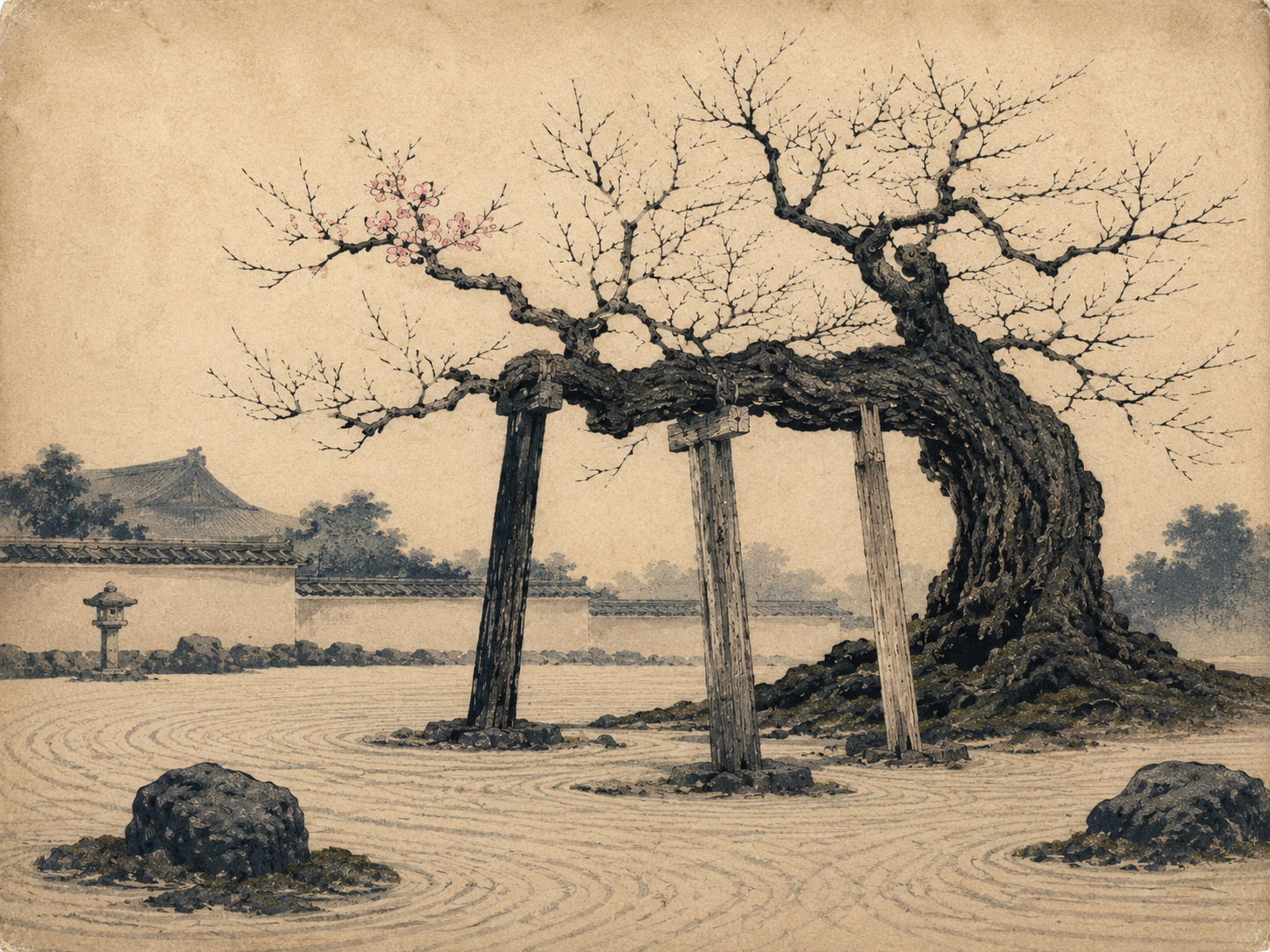
The garden behind it had been raked that morning, and looked as though it had been raked every morning for a thousand years. A single cherry tree stood bare at its centre, so old that its lower limbs rested on cedar crutches, and the crutches themselves were grey with age and had plainly been replaced, and replaced, and replaced. The tree had not.
Yuki met her at the gate: tall, unhurried, silver at the temples. Maya had brought the knife — her own, the new one — wrapped in a tea towel in her rucksack like a hostage.
"You want to return it," Yuki said, as they walked. She said it the way you might try a phrase in a foreign language, carefully, checking the shape of it.
"I want it to be of use. It isn't, in my drawer."
"And the other one is."
"The other one was my grandmother's."
"And you use it."
"Every day." She heard how that sounded — like a defence. "It's the better knife."
"It is not," Yuki said, without heat. "They came off the same bench. But I take your meaning. People keep things, or they keep faith with things. Your family did both, for six generations, without once needing us. Do you know how rare that is?"
"I'm the last of them," Maya said. She had not meant to say it first. "I already know this line ends with me."
She had said this before, to other people, and watched them arrange their faces into sympathy. Yuki did not. She nodded once, as though Maya had given a correct and rather promising answer.
"Yes," she said.
They walked. Maya had come with questions stacked like firewood, and found, in the quiet, that most of them had been about the wrong thing. She had meant to ask how. How do you promise a thousand years; how do you honour a guarantee written before your great-grandmother was born. Standing in a garden that had outlived every government that ever tried to tax it, the how seemed a smaller question than it had at home.
"Why," she asked instead, at the cherry tree. "Why knives and chairs and bridges? Why spend" — she chose the word with care, because the garden seemed to ask for it — "centuries at it?"
"Why does anyone do anything meant for after they've gone?"
"Most people don't."
"Most people do," Yuki said. "They have children."
Maya looked at her.
"It is the same instinct. Someone must be downstream of me. Most people answer it the usual way, and the answer holds. It's a good answer — it pours everything forward and asks for nothing back." She touched the trunk of the cherry as they passed, so lightly it might have been an accident. "But it was never going to fit everyone."
Maya thought of the card in her kitchen drawer. The guarantee passes to your heirs.
"It's who you sell to, though. It's on the card. Heirloom grade. You're selling to the people it fits."
"Almost always. A name already in mind for the second line of a card. They are the business, and we are glad of them." Yuki walked a few steps before going on. "And once in a long while, somebody buys a thousand years with nobody in mind at all. No heirs, no name. Wanting the thing to go onward anyway — onward to nobody in particular." She glanced across, mild. "You said it at my gate. I want it to be of use. It is not a common thing to want, what you want. Sermons don't produce it. We have tried sermons, at various times. They don't take."
"So what does?"
"A knife their grandmother used, that still cuts." Yuki shrugged. "The future goes solid in the hand. That is the entire business. Everything else is metallurgy."
"You choose people," Maya said. It was not quite a question.
"We are very old and very few, and we have learned to look for the ones whose someone downstream has nowhere to go. The ones with children have theirs spoken for, and good luck to them. Yours has been loose your whole life. You have been calling it not wanting a family."
In the workshop there was a wall of photographs, reaching back further than photographs were supposed to. Workbenches; masters mid-strike; apprentices holding blades up to windows that were recognisably these windows. The faces changed as the prints yellowed, and changed, and changed. Maya walked the length of it once, slowly, and did not walk it a second time. Some questions you ask. Others you decide, in a raked garden, in winter, to leave exactly where they are.
As for the surplus knife: they would not buy it back. But there was a waiting list, and some of the names on it had been there for years. The knife could go to one of them — box, blade and card together.
"The back of the card is blank," Maya said.
"For now. Whoever takes it up may sign it, or may not. Some cards stay blank for a century and then begin. It is not ours to start."
Maya thought of six names in six different inks, and of the room below the sixth, and found she had decided about that, too, on some train she could not now remember boarding.
"Show me how it's done," she said.
V.
The bridge in Norway opened in 2044.
The council of a small coastal town had said yes, in the end, to the ten-thousand-year guarantee — the eighth ever issued. Saying yes had taken them six years and two elections. Councils are supposed to think past themselves; it is, on paper, the whole job. In practice their horizon was the next vote, and the figure had frightened them. But it was done: somewhere in the minutes of an ordinary planning meeting, an ordinary town had agreed to be answerable to the fortieth century. Æternum considered that, quite apart from the bridge, the product delivered.
The letter crossed Maya's desk, because by then a great deal crossed Maya's desk. The bridge was local stone and clean lines and would take the weight of people not yet imagined. Æternum filed the guarantee without anxiety — the way you sign for a parcel you fully intend to be home to receive. One of the older among them read the term over her shoulder and remarked that he had once helped throw bridges across rivers for an empire that had not lasted as long as the bridges did, and that the first thousand years were the hard part. He said it the way other people mention the weather.
Maya had taken the work nearly twenty years before, and meant to keep it as long as it would have her — which, she now understood, was a longer offer than it had sounded.
Her first knife, serial 2023-00943, was in Lisbon, with a stranger from the waiting list. Whether its card had begun she did not know; it was none of her business, and she wondered about it roughly weekly. Elsa's stayed with her, and went on going through onions. Its card carried seven names now. She had signed it her first winter here, with a pen borrowed from Yuki, in the smallest hand on the page.
In the workshop she shaped a blade from steel that had been folded back on itself more times than there were words to count, and thought, as she always did, of the column of names on the back of a tea-coloured card — Elsa, and all the women after her, down to her grandmother, and then her own. She had been the end of one line. She had turned out to be the beginning of a different one — the kind that does not run through children, the kind she had been quietly joining since long before she knew it had a door.
She held the finished blade up to check the edge, and her own face came back at her out of the metal: the same face, the storm moving slowly behind it, in no hurry, with nowhere it had to be. She had stopped doing the arithmetic on that some years ago.
Outside, the old cherry came into blossom on its cedar crutches. It would do it again next year, and the year after, and the year after that.
Some things lasted. That was the whole point.
AUTHOR'S NOTES
Research background
The premise rests on real ground, kept load-bearing but mostly off-stage:
- Shinise (老舗). Japan has tens of thousands of companies past their first century, a few hundred past five hundred years, and a handful claiming more than a millennium of continuous trade. Kongō Gumi, a temple-building firm, dated itself to AD 578 before being absorbed in 2006. Shinise — "old shop" — carries real cultural weight: stewardship, intergenerational patience, the firm as something handed on rather than cashed out.
- The deep-time imagination. The ethos of planning past a single human lifespan — clocks and institutions built to run for ten thousand years — sits underneath Æternum's ten-thousand-year tier, folded into the worldview rather than name-checked.
- Planned obsolescence inverted. Where planned obsolescence manufactures repeat custom through designed failure, planned permanence makes its money on reliability and stewardship. Patagonia's repair guarantee, Victorinox's no-expiry knives, and the Japanese craft traditions all point at the door Æternum walks through.
Themes
- Deep time — running a firm whose planning horizon outruns its planners; making politicians answerable to the fortieth century.
- Object permanence — physical things as carriers of memory across generations.
- Stewardship — building for descendants you will never meet.
- Continuity without inheritance — a legacy poured into the world rather than into children; the childed and the childless answering the same instinct two different ways; immortality reframed as custodianship, never named outright.
METADATA
| Field | Value |
|---|---|
| Created | 2026-07-02 |
| Model | anthropic/claude-fable-5 |
| Human | Caspar Addyman |
| Agent | Claude (Cowork) |
| Prompt (original seed) | "Craft a compelling short story around a company that succeeds because it offers Products with 10, 100, 1000 (10000?) year guarantee instead of 'lifetime warranty'. Do background research on super long lasting corps in Europe and Japan. But think also about the long now, the far future and maybe have a plot twist that it is run by (benevolent?) vampires or other immortals." |
| Prompt (v4 brief) | Caspar's inline %%comments%% + direct edits on v3 (2026-07-02): card carries names only, each keeper self-signing, grandma last; Æternum has no knowledge of its products' lives (no servicing history, no tracking) — Maya's letter explains the two knives and they react; heirloom-grade contradiction fixed (heirs are the normal customer, Maya's kind the rare exception); toaster joke cut; Norway council beat reworked around politicians and the ten-thousand-year horizon. Consistency sweep before drafting, redundancy sweep after. |
| Research | Shinise / Kongō Gumi; deep-time / long-horizon thinking (informs the ethos, unnamed in prose); planned-obsolescence inversion. Carried over from v1–v3. |
| Draft | 4 — logic and knowledge-economy repairs on v3's structure. See revision notes. |
| Word count | ~2,850 |
| Status | Draft |
Reference passage — Monumenta (Lara Haworth, p. 80)
See also: Monumenta
'Malina should have left him years ago,' said Olga.
'My only concern with Misha, Danilo, is that he is so old.'
And in its ordinariness, this was the greatest thing his mother had ever said to him.
Olga began scoring each pepper off at the top, pulling the seeds out with the tip of her knife, rooting out the bitter black stalks that lurked underneath. 'I used to take my knife to state dinners. Your father thought I was mad. I put it in my handbag, underneath my tissues. It made me feel strong.' She touched the blade, which never seemed to need sharpening, never seemed to blunt, or be affected by events outside of it. 'Ukrainian steel.'
Hilde asked if she could see it, and Olga passed her daughter the knife and thought how, in time, she would again pass on the knife to Hilde, but be unable to do so in person, only in deed, and this made something seize in her throat, which Hilde - Hilde! - seemed to read. Was there any truer inheritance for a daughter than a knife?
Tags: #fiction #short-story #shinise #planned-permanence #deep-time #confabulation