
Will You Live in Exponential Times?
Part one measured thirteen technology curves and how far ahead anyone can honestly see. This part asks what they add up to by 2031, five years from now. The short answer is: more than the curves say.

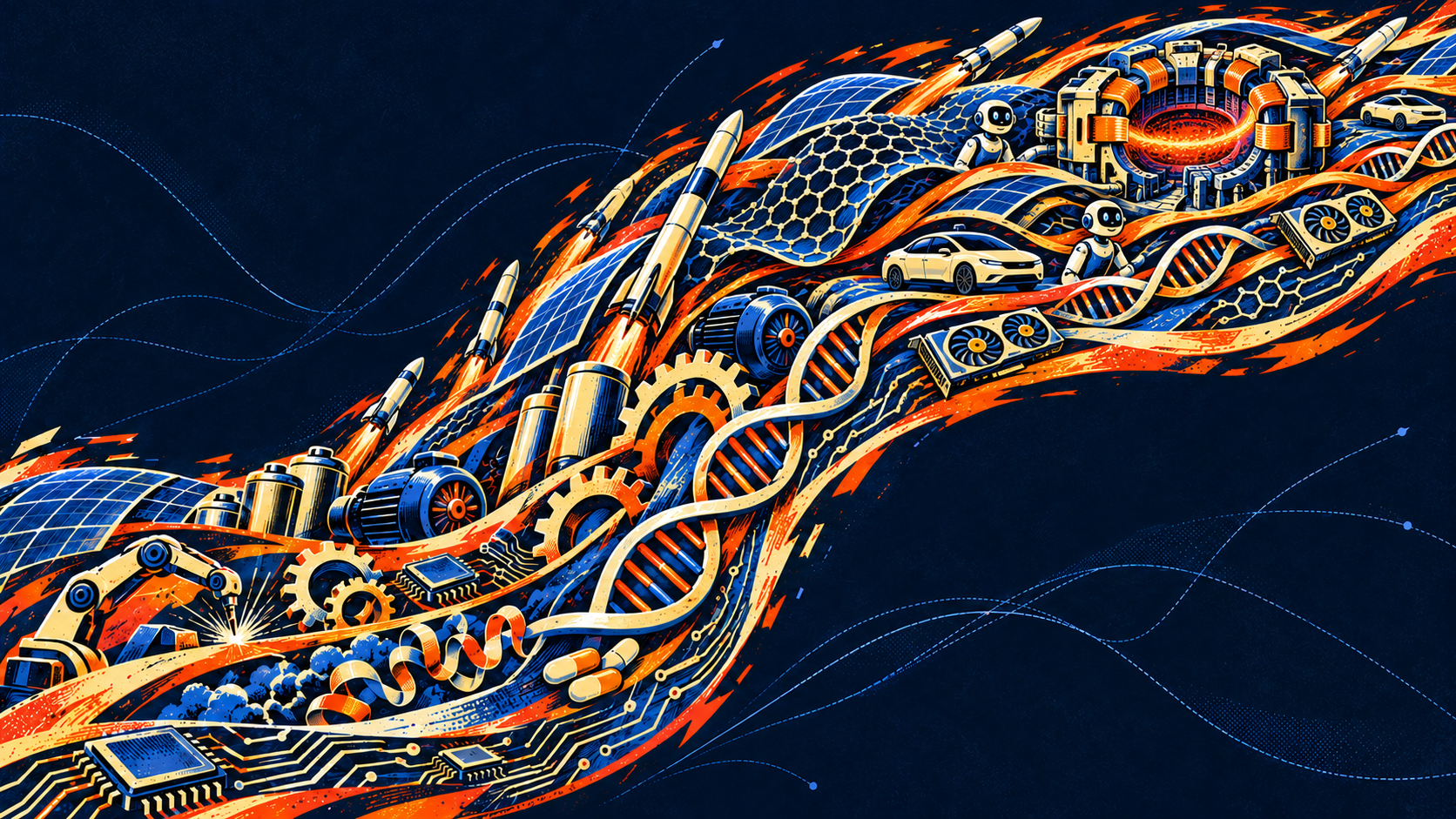
Part one measured thirteen technology curves and how far ahead anyone can honestly see. This part asks what they add up to by 2031, five years from now. The short answer is: more than the curves say.
"The future is already here. It's just not very evenly distributed." — William Gibson
Revolutions make you dizzy
On 4 September 1882, Thomas Edison switched on the Pearl Street power station and lit up a few blocks of lower Manhattan. Factories took about forty years to notice.
In 1899, electric motors drove about 5% of the machinery in American factories. By 1919 it was about half, and by 1929 about 78% (David, 1990). The delay was the buildings. A factory was laid out around one huge steam engine and a spinning shaft, with every machine belted to it. Swapping in one big electric motor changed nothing. The gain came when someone put a small motor on each machine and rebuilt the factory around the work. Then productivity growth more than doubled.
The price of electricity fell smoothly the whole time. That was the exponential, and it was the boring part. What changed people's lives was everything that happened because of it.
That's the argument of this essay. Part one fitted smooth curves to thirteen technologies. Three things make the next five years bigger than any of those curves:
- The flip. A technology crosses a threshold, usually price, and takes over a market in a few years.
- The sweep. Several flips happen at once, feed each other, and a whole part of the economy changes.
- The jump. Something comes off the chart altogether, up or down.
How a thing takes over
Nothing grows exponentially for ever. Real adoption follows an S-curve: a slow start, a steep middle, then a ceiling, because you can't sell electric cars to more than 100% of buyers. The cruel trick is that an S-curve looks exactly like an exponential until it's halfway up. You only see the bend once you're past it.
The steep middle of the S is the flip, and it is fast.
| What | Before | After |
|---|---|---|
| Electric share of new cars, Norway | 17% (2015) | about 98% (2026) |
| Electric and plug-in share of new cars, China | 5% (2020) | 65% (August 2026) |
| Americans taking a weight-loss jab | approved June 2021 | 1 in 8 adults (November 2025) |
| ChatGPT | launched November 2022 | 900 million users a week (February 2026) |
Sources: electrive, CnEVPost, KFF, TechCrunch.
Notice what's underneath. Battery prices fell 13 to 16% a year, every year, for three decades. Nothing dramatic happened to the cost curve in 2020. But once an electric car was cheaper to own than a petrol one, the markets turned over. China went from one new car in twenty being electric to two in three in about six years. Norway went from one in six to nearly all of them in ten. The exponential is the cause. The S-curve is what you feel.
The weight-loss jabs are the fastest flip on the list, and they haven't finished. A pill version was approved in the US in April 2026, fifty days after the application went in (Healio). Cheap generic versions went on sale this year in Canada, India and Brazil, in India for as little as a few pounds a month (ThePrint).
So the useful question about any technology isn't how fast it's growing. It's where it sits on its S. Below the threshold, nothing seems to happen. Above it, everything does.
Sweep one: electrotech takeover
A year ago, in "To Boldly Grow", I reported on the energy think tank Ember's argument that solar panels, wind turbines, batteries, electric cars and heat pumps are really one machine, which they call electrotech (Ember, 2025). Each one makes the others cheaper.
This September Ember went further (Ember, 2026). Electrotech and information technology, they argue, are two halves of one revolution. A phone, an AI server, an electric car and a heat pump are built from the same five parts: chips, sensors, batteries, power electronics and motors. The smartphone made the battery cheap enough for the car, and the car made it cheap enough for the grid. The combined cost of those parts has fallen 99% since 1990.
That is a sweep: many flips feeding each other at once. China installed 315 gigawatts of solar in 2025 alone, more than half the world's total. Data centres, driven by AI, are on course to use as much electricity by 2030 as Japan does today (IEA), and the AI companies are paying for new power to get it. Meanwhile a grid full of solar and batteries needs computing to keep it balanced. Each half now needs the other.
Ember's own summary is that three in four people on Earth could already get round-the-clock solar-and-battery power for under $100 a megawatt-hour. Their line for the next few years: "What is cheap today will be irresistible by 2030."
Sweep two: stacking atoms
In a factory outside Beijing, Xiaomi makes about one phone every three seconds, around the clock, with no production workers on the floor. It's called a dark factory, because robots don't need the lights on (New Atlas). BYD says its plant in Zhengzhou builds about one electric car a minute (Kathmandu Post).
China installed 54% of all the new industrial robots in the world in 2024 (IFR). Ember reckons that combining electric power with automation cuts manufacturing costs by 40 to 70%. And the robots are leaving the factory: Unitree sells a humanoid robot in China for about $4,300 (SCMP). It isn't very useful yet. Neither was the first electric car.
The sweep here is speed as much as cost. The fashion company Shein makes a new design in a batch of a hundred or two, watches whether it sells, and makes more only if it does. The gap from design to production is about a week. Factories are turning from fixed machines into software you can rewrite.
The same loop runs in space. Reusable rockets cut the cost of a kilo to orbit about twentyfold (NASA). That made it worth launching about 11,000 Starlink satellites, and Starlink now pays for the rockets. As the investor Tomasz Tunguz put it after reading SpaceX's stock-market filing, "Starlink funds the enterprise" (Tunguz, 2026). In 2025, 122 of SpaceX's 170 launches carried its own satellites.
Sweep three: health magic
In 2025 doctors in Philadelphia wrote a gene edit for one baby, KJ Muldoon, born with a rare liver disease, and gave it to him months later (NEJM). By February 2026 his case was the model for new draft guidance from the US regulator on treatments built for a single patient. One estimate puts the next ones at about three months and under $250,000 each (CRISPR Medicine News).
In August 2026 a cancer vaccine made from each patient's own tumour passed its final-stage trial in melanoma, alongside an existing drug (Merck). The NHS plans to offer trials of personalised cancer vaccines to 10,000 patients by 2030.
And AI is designing the drugs. AlphaFold, which predicts the shapes of proteins, won its makers a Nobel prize in 2024. By mid-2026, 117 drug candidates found with AI were in human trials (IntuitionLabs). One, for a lung-scarring disease, started its final phase in July. None is approved yet.
The loop: cheaper genome sequencing gives AI more biology to learn from, AI designs better drugs and edits, and every success makes the regulators faster at the next one. Add the weight-loss jabs, which went from approval to one in eight American adults in four years, and medicine is flipping in several places at once.
Sweep four: sand that thinks
Part one tracked how long a task an AI agent can do on its own and get right half the time. It has been doubling about every six months. Carry that to 2031 and the central line reaches about 12,000 hours of human work, six working years. The honest band runs from two working weeks to more than anyone could measure.
If you had to bet on which end, bet high. In October 2026 Benjamin Todd marked eighteen months of AI forecasts, his own included (Todd, 2026). Almost everyone was too slow. The AI company bosses, usually accused of hype, were the only group ahead of events, and only slightly. Todd expected AI to score 32% on FrontierMath, a fiendish test written by research mathematicians, by the end of 2026. It scored 94% by September. "AI is just extremely hard to predict," he writes, "but that doesn't mean it'll come slow."
The sweep is that thinking now runs on the same stack as everything else. The AI that writes code is learning to drive cars, fold laundry and design proteins. Every sweep above has AI inside it, and AI needs every one of them: power to run, factories to build its chips, biology to learn from.
Scream if you want to go faster..
The bands in part one are wide in both directions, and people tend to treat the top as hype. History says that when people decide to push, the top is reachable.
| What | Before the push | After |
|---|---|---|
| Building a Liberty cargo ship | about 230 days (1941) | 39 days (1943); record 4 days 15 hours |
| US military aircraft a year | under 3,000 (1939) | 96,270 (1944) |
| A new vaccine | about 4 years (mumps, 1960s) | 11 months (COVID, 2020) |
Sources: Liberty ships, US aircraft, Healio.
Every push had three things: a buyer for everything that could be made, permission to skip the queue, and know-how that already existed. A push makes things faster. It is bad at inventing them.
The queue is the real brake. By early 2025 the projects waiting to plug into Britain's grid added up to about 756 gigawatts, so many that the grid operator had to stop and sort the queue (summary). In America a new project waits more than five years to connect (Berkeley Lab). The panel gets cheaper on schedule, then waits for a transformer and someone from the council.
Some tops can't be reached however hard anyone pushes. The top of the 2031 band for Waymo is 24 billion rides a week, three for every person on Earth. That isn't a forecast. It's an exponential that doesn't know it's an S-curve. A push can get you up the S faster. It can't move the ceiling.
Off the chart (up): more revolutions
Every jump starts as a paper, and papers take a long time to reach you. Graphene was isolated in 2004 and is still mostly a coating. CRISPR was published in 2012 and first approved as a treatment in 2023. The mRNA trick behind the COVID vaccines was published in 2005. So the jumps of 2031 are already in the journals. On 28 October 2026 Nature published a ribbon of carbon a few atoms wide that conducts like a metal, predicted in 1996 and made thirty years later (Huang et al., 2026). It might be the start of wiring made of pure carbon. It might be graphene again.
A superconductor. In 2023 a team claimed LK-99 carried electricity with no resistance at room temperature. Three weeks later it was dead (Nature). If one ever survives, the 8% of the world's electricity lost in wires starts to vanish, power flows from the Sahara to Stockholm, and MRI scanners and fusion magnets get far cheaper. But the last new kind of superconductor, in 1986, took thirty-five years to become a useful magnet.
Fusion. For decades fusion was thirty years away and the data agreed. Now the points are coming faster. America's National Ignition Facility got more energy out than its lasers put in for the first time in December 2022, and by April 2025 it got four times as much out (LLNL). Helion has a contract to sell Microsoft fusion electricity from 2028. Commonwealth Fusion's SPARC machine aims to make more fusion power than it takes to heat its plasma in 2027, and Google has signed up for the plant after it. Private fusion companies have raised $14 billion. If Helion is on time, fusion electricity reaches a grid inside my five years. It still wouldn't touch your bill.
AI building AI. If AI gets good enough at AI research to speed up its own progress, every curve in this essay gets a new engine (AI 2027). Its authors have moved their central date back and forth by years in a single year. That's the band talking.
Off the chart (down): reality bites
Jumps go down too, and three of the biggest are already in motion.
The strait. In 2022 about 70% of the world's capacity to make the most advanced chips was in Taiwan, about a hundred miles off the Chinese coast (BCG/SIA). Every computing curve, and so every sweep above, assumes that keeps working. A blockade wouldn't bend those curves. It would cut them off.
The gap. Not every fall is a crash. Some are just being left behind. Europe 2031, a scenario published this June by a group of European AI researchers and policy people (Juijn et al., 2026), imagines Europe sliding out of the race one sensible-looking decision at a time. By March 2031 in their story, the US has about twelve times Europe's computing power, 255 gigawatts to 21. Washington then offers every European about €100 a year in AI payouts in exchange for control of ASML, the Dutch company that makes the machines the most advanced chips are printed with. It's fiction, but it's built the way this essay is: carry today's curves forward and ask who ends up on which side of them. A flip doesn't arrive everywhere at once. If the sweeps above happen, where you live in 2031 may matter as much as when.
Climate. Warming looks like the slowest, steadiest curve there is: about 0.27 °C a decade, set to pass 1.5 °C as a long-term average around 2030 (Forster et al., 2026). But the Earth has S-curves of its own. In October 2025 the Global Tipping Points Report concluded that warm-water coral reefs have already passed their tipping point, at around 1.2 °C, and are "vanishing" (GTP Report). The Amazon, the great ice sheets and the Atlantic current system that keeps Britain mild are approaching theirs. In one 2025 study, that current system shut down by 2300 in about a third of model runs even under moderate emissions (Drijfhout et al.), though the IPCC still judges collapse this century very unlikely.
A tipping point is a flip with the sign reversed. Below it, nothing seems to happen. Above it, the change runs on its own, and no push brings it back.
p(doom): The number with no curve
Which brings me to p(doom), the chance that AI goes so badly it ends us. It started as Silicon Valley small talk and has become something people are expected to have, like a star sign.
Most p(doom)s have no date and no definition. Geoffrey Hinton says 10 to 20% within 30 years (Guardian). A survey of 2,778 AI researchers got a median of 5% for "extremely bad outcomes", with no date at all (Grace et al., 2024).
The one careful attempt was a tournament run by the Forecasting Research Institute in 2022 (Karger et al., 2023). It asked experts and superforecasters the same question: AI-caused extinction by 2100. The experts said 3%, the superforecasters 0.38%. The same superforecasters said the biggest AI training run would cost $35 million by 2024. It probably cost over $100 million (Todd, 2026). That settles nothing about doom. But the group with the lowest number was also the group most surprised by how fast things moved.
In a follow-up, the most worried and the least worried argued it out for weeks. They finished at 20% and 0.12%, a gap of about 170 times, and neither side moved much (FRI, 2024). With no data to fit, the number tells you more about the person holding it than about the robots.
My own prior is a ratio, not a number. I think AI is about ten times less likely to end humanity than humanity is. I, for one, welcome our new robot overlords. I don't see them enslaving, replacing or destroying us any more efficiently than we will manage ourselves. For the serious version of the worry, about who gets to point these machines at which hill, I've written that one too.
Ten bets for 2031
Part one ended with a scorecard for next October. Here is one for October 2031. The first six come from carrying part one's curves a year further, with 90% bands, so about one in ten should miss. The seventh is the climate scientists' own projection. The last three are my guesses.
- Solar. The world has about 10 terawatts of solar panels installed (7.5 to 13).
- Batteries. Lithium-ion cells cost about $23 a kilowatt-hour ($9 to $64), against about $74 today.
- Cars. About three in four new cars sold worldwide are electric (47% to 93%).
- AI. The best AI agent can do, half the time, a task that takes a person about six working years (from two weeks to beyond measurement).
- Genomes. Reading a whole human genome costs about $60 ($2 to $1,850).
- Robotaxis. Waymo gives about 20 million rides a week, forty times today's 500,000. That's my number, not the method's. The method says 180 million, in a band from 1.3 million to an impossible 24 billion, because it doesn't know it's on an S-curve.
- Warming. The long-term average has passed 1.5 °C.
- Medicine. At least one drug found with AI is approved somewhere. I'd put this at 95%. The COVID vaccines showed how fast approval can move when it matters.
- Fusion. A fusion power plant has sold electricity to a paying customer for a whole month. A few minutes of fusion power on a grid, for the cameras, doesn't count. I'd put this at 20%.
- The flip I didn't see. Something neither essay mentions has done what the weight-loss jabs did: gone from launch to one in eight adults in the US or UK within five years. I'd put this at 50%.
See you in October 2031. Most of it will feel ordinary while it happens. That's what exponential times feel like from the inside: ordinary, and ordinary, and ordinary, and then one morning the factory has been rebuilt on one floor and nobody can remember the shaft.